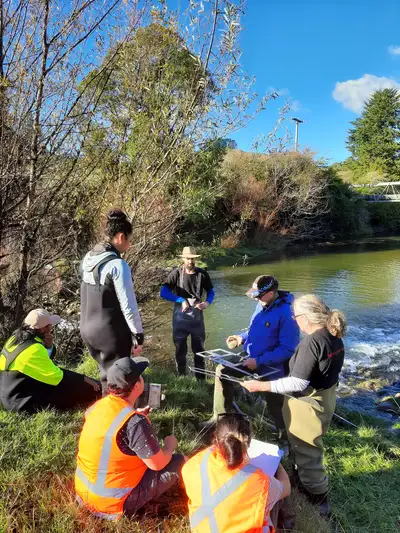
What we do
We focus on two main areas within river science, fluvial geomorphology and fresh water ecology.
Fluvial geomorphology
Fluvial geomorphology is about the physical structure of river channels and how they change in space and time, shaped by the interaction between water, sediment and vegetation.
Expertise:
- river channel dynamics and interaction with river habitat
- flood histories and catchment response to environment change
- slope-channel coupling and catchment connectivity
- resilience in riverine environments
Freshwater ecology
Within freshwater ecology we focus on hydro-geomorphological determinates of biological diversity. This includes applied research on setting high flows, water abstraction, biological assessment methodologies, impacts of sedimentation and biological conservation.
Expertise:
- fresh water ecosystem
- invertebrates
- fish
Who we are

Professor Ian Fuller

Dr Russell Death
Our research
We do research covering a range of issues relating to river solutions.
River natural character index (NCI)
The NCI is an approach developed to understand the extent to which river habitat / geomorphology has been modified by deliberate human intervention in river channels.
Initially focusing on historic changes in channel form in response to past river engineering, the NCI can also be deployed as a monitoring tool to track changes in river form in response to current management practices and the potential impact of design channels.
The approach is outlined in a published paper and has been applied across a range of rivers, including:
- Rangitikei
- Waikanae
- Otaki
- Hutt
- Ngaruroro
- Motueka
- SE Ruahine streams.
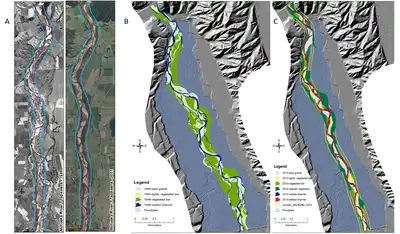
Channel changes in the Motueka 1946-2015. A. 1948 aerial photograph overlaid with intended channel fairway (river corridor) design lines and extent to which the managed channel sits within these lines in 2001, B. channel morphology mapped from 1946 aerial photography, C. channel morphology mapped from 2012 aerial photography (2015 wetted channel mapped from Google Earth).
Gravel Extraction Habitat Advice
The report in 2021 for Horizons Regional Council provides a desk-based review of published and unpublished studies assessing the impacts of gravel extraction on river habitat and stream health.
This informed and provided the basis for recommending:
- technical assessments of gravel extraction
- data required from applicants to assess gravel extraction applications
- best practice guidelines for gravel extraction
- monitoring requirements for gravel extraction consents.
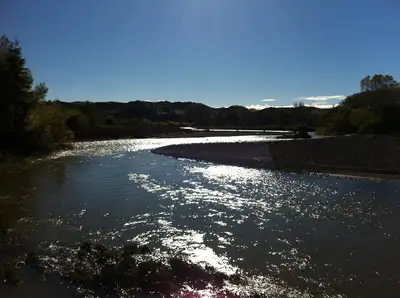
River geomorphology toolbox workshop
The River Geomorphology Toolbox uses a concept and approach developed by Teryll Lepper for her MSc thesis to assess river health in wadable streams from a geomorphology perspective.
The first field-based workshop run for Gisborne District Council in the Waingake catchment focused on helping community groups understand the ideas and tools in order to take the toolbox to their own streams.